Hand & Stone Massage and Facial Spa Reviews
| Mitt | |
|---|---|
 The back (left) and forepart (correct) of the two easily of a male person homo | |
 X-ray of human hand | |
| Details | |
| Vein | Dorsal venous network of hand |
| Nerve | Ulnar, median, radial nerves |
| Identifiers | |
| Latin | Manus |
| MeSH | D006225 |
| TA98 | A01.1.00.025 |
| TA2 | 148 |
| FMA | 9712 |
| Anatomical terminology [edit on Wikidata] | |
A hand is a prehensile, multi-fingered appendage located at the end of the forearm or forelimb of primates such as humans, chimpanzees, monkeys, and lemurs. A few other vertebrates such as the koala (which has two opposable thumbs on each "hand" and fingerprints extremely similar to human fingerprints) are often described every bit having "hands" instead of paws on their front limbs. The raccoon is usually described as having "hands" though opposable thumbs are defective.[1]
Some evolutionary anatomists use the term hand to refer to the appendage of digits on the forelimb more generally — for example, in the context of whether the three digits of the bird hand involved the same homologous loss of 2 digits as in the dinosaur hand.[ii]
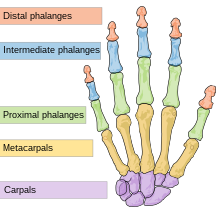
The human being hand usually has five digits: 4 fingers plus one thumb;[3] [4] these are often referred to collectively as five fingers, notwithstanding, whereby the thumb is included as one of the fingers.[3] [v] [6] It has 27 bones, not including the sesamoid bone, the number of which varies amongst people,[7] fourteen of which are the phalanges (proximal, intermediate and distal) of the fingers and pollex. The metacarpal bones connect the fingers and the carpal bones of the wrist. Each human paw has five metacarpals[8] and eight carpal basic.
Fingers contain some of the densest areas of nerve endings in the body, and are the richest source of tactile feedback. They also have the greatest positioning capability of the body; thus, the sense of touch is intimately associated with hands. Like other paired organs (eyes, feet, legs) each hand is dominantly controlled past the opposing brain hemisphere, so that handedness—the preferred manus option for single-handed activities such every bit writing with a pencil, reflects individual brain functioning.
Among humans, the hands play an important role in body language and sign language. Likewise, the x digits of 2 hands and the twelve phalanges of four fingers (touchable by the pollex) have given rise to number systems and adding techniques.
Structure
Many mammals and other animals accept grasping appendages similar in course to a hand such every bit paws, claws, and talons, but these are not scientifically considered to be grasping hands. The scientific utilize of the term manus in this sense to distinguish the terminations of the front end paws from the hind ones is an instance of anthropomorphism. The only true grasping hands appear in the mammalian society of primates. Hands must also accept opposable thumbs, as described later on in the text.
The hand is located at the distal end of each arm. Apes and monkeys are sometimes described as having four easily, considering the toes are long and the hallux is opposable and looks more than similar a thumb, thus enabling the anxiety to exist used as hands.
The discussion "hand" is sometimes used by evolutionary anatomists to refer to the appendage of digits on the forelimb such every bit when researching the homology between the 3 digits of the bird mitt and the dinosaur paw.[2]
An adult human male'southward hand weighs nigh a pound.[9]
Areas

Areas of the man paw include:
- The palm (Volar), which is the central region of the inductive part of the hand, located superficially to the metacarpus. The pare in this area contains dermal papillae to increase friction, such as are besides present on the fingers and used for fingerprints.
- The opisthenar area (dorsal) is the corresponding area on the posterior part of the manus.
- The heel of the mitt is the area anteriorly to the bases of the metacarpal basic, located in the proximal role of the palm. It is the area that sustains almost pressure when using the palm of the mitt for support, such as in handstand.
There are five digits attached to the hand, notably with a nail fixed to the stop in place of the normal hook. The four fingers tin be folded over the palm which allows the grasping of objects. Each finger, starting with the one closest to the thumb, has a colloquial name to distinguish it from the others:
- index finger, pointer finger, forefinger, or 2nd digit
- middle finger or long finger or tertiary digit
- ring finger or 4th digit
- little finger, pinky finger, small-scale finger, babe finger, or 5th digit
The thumb (connected to the starting time metacarpal bone and trapezium) is located on ane of the sides, parallel to the arm. A reliable way of identifying human being easily is from the presence of opposable thumbs. Opposable thumbs are identified by the ability to be brought contrary to the fingers, a musculus action known as opposition.
Basic
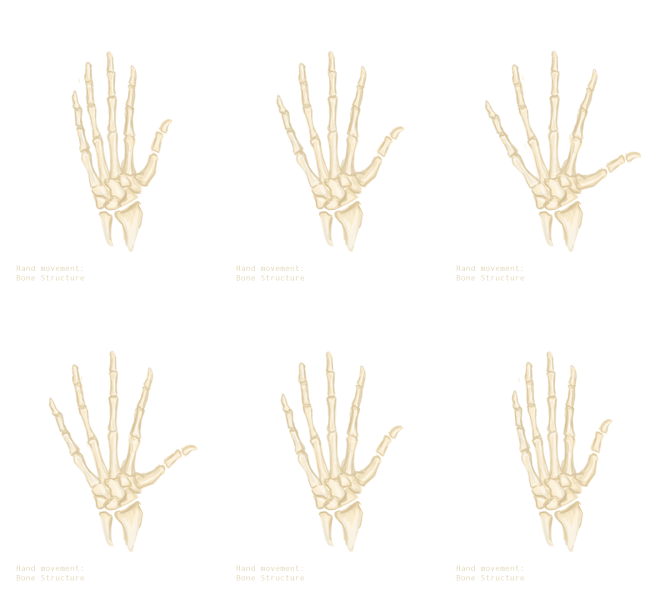
Mitt-os blitheness (metacarpal movement is exaggerated, other than on the thumb)

The skeleton of the man hand consists of 27 bones:[10] the eight brusk carpal bones of the wrist are organized into a proximal row (scaphoid, lunate, triquetral and pisiform) which articulates with the bones of the forearm, and a distal row (trapezium, trapezoid, capitate and hamate), which articulates with the bases of the five metacarpal bones of the hand. The heads of the metacarpals will each in plough articulate with the bases of the proximal phalanx of the fingers and thumb. These articulations with the fingers are the metacarpophalangeal joints known equally the knuckles. At the palmar aspect of the first metacarpophalangeal joints are small, virtually spherical bones called the sesamoid bones. The fourteen phalanges make up the fingers and thumb, and are numbered I-Five (thumb to pinkie) when the manus is viewed from an anatomical position (palm upwardly). The iv fingers each consist of three phalanx bones: proximal, middle, and distal. The thumb simply consists of a proximal and distal phalanx.[11] Together with the phalanges of the fingers and thumb these metacarpal bones form five rays or poly-articulated chains.
Because supination and pronation (rotation about the axis of the forearm) are added to the ii axes of movements of the wrist, the ulna and radius are sometimes considered part of the skeleton of the hand.
In that location are numerous sesamoid bones in the hand, small-scale ossified nodes embedded in tendons; the verbal number varies between people:[7] whereas a pair of sesamoid bones are found at virtually all thumb metacarpophalangeal joints, sesamoid bones are likewise common at the interphalangeal joint of the thumb (72.ix%) and at the metacarpophalangeal joints of the niggling finger (82.5%) and the alphabetize finger (48%). In rare cases, sesamoid basic have been constitute in all the metacarpophalangeal joints and all distal interphalangeal joints except that of the long finger.
The articulations are:
- interphalangeal articulations of hand (the hinge joints betwixt the bones of the digits)
- metacarpophalangeal joints (where the digits see the palm)
- intercarpal articulations (where the palm meets the wrist)
- wrist (may also exist viewed equally belonging to the forearm).
Arches

Arches of the hand
Red: i of the oblique arches
Dark-brown: one of the longitudinal arches of the digits
Dark green: transverse carpal arch
Light green: transverse metacarpal arch
The fixed and mobile parts of the hand adapt to various everyday tasks past forming bony arches: longitudinal arches (the rays formed by the finger bones and their associated metacarpal basic), transverse arches (formed past the carpal bones and distal ends of the metacarpal bones), and oblique arches (betwixt the pollex and four fingers):
Of the longitudinal arches or rays of the hand, that of the thumb is the well-nigh mobile (and the least longitudinal). While the ray formed by the pinkie and its associated metacarpal os all the same offers some mobility, the remaining rays are firmly rigid. The phalangeal joints of the alphabetize finger, however, offering some independence to its finger, due to the arrangement of its flexor and extension tendons.[12]
The carpal bones form two transversal rows, each forming an arch concave on the palmar side. Considering the proximal arch simultaneously has to adapt to the articular surface of the radius and to the distal carpal row, it is by necessity flexible. In contrast, the capitate, the "keystone" of the distal arch, moves together with the metacarpal bones and the distal curvation is therefore rigid. The stability of these arches is more dependent of the ligaments and capsules of the wrist than of the interlocking shapes of the carpal basic, and the wrist is therefore more stable in flexion than in extension.[12] The distal carpal arch affects the function of the CMC joints and the easily, simply not the function of the wrist or the proximal carpal arch. The ligaments that maintain the distal carpal arches are the transverse carpal ligament and the intercarpal ligaments (also oriented transversally). These ligaments besides grade the carpal tunnel and contribute to the deep and superficial palmar arches. Several muscle tendons attaching to the TCL and the distal carpals also contribute to maintaining the carpal arch.[13]
Compared to the carpal arches, the arch formed by the distal ends of the metacarpal bones is flexible due to the mobility of the peripheral metacarpals (thumb and little finger). As these two metacarpals approach each other, the palmar gutter deepens. The fundamental-most metacarpal (middle finger) is the well-nigh rigid. It and its two neighbors are tied to the carpus by the interlocking shapes of the metacarpal bones. The thumb metacarpal just articulates with the trapezium and is therefore completely independent, while the fifth metacarpal (pinkie) is semi-independent with the quaternary metacarpal (ring finger) which forms a transitional element to the fifth metacarpal.[12]
Together with the thumb, the four fingers form four oblique arches, of which the arch of the index finger functionally is the most important, especially for precision grip, while the arch of the pinkie contribute an important locking mechanism for ability grip. The thumb is undoubtedly the "primary digit" of the hand, giving value to all the other fingers. Together with the index and middle finger, it forms the dynamic tridactyl configuration responsible for most grips not requiring forcefulness. The band and little fingers are more static, a reserve gear up to interact with the palm when great force is needed.[12]
Muscles
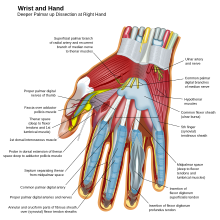
Muscles and other structures of wrist and palm
The muscles acting on the hand can be subdivided into two groups: the extrinsic and intrinsic musculus groups. The extrinsic muscle groups are the long flexors and extensors. They are called extrinsic because the muscle belly is located on the forearm.
Intrinsic
The intrinsic musculus groups are the thenar (pollex) and hypothenar (footling finger) muscles; the interosseous muscles (four dorsally and three volarly) originating betwixt the metacarpal bones; and the lumbrical muscles arising from the deep flexor (and are special because they have no bony origin) to insert on the dorsal extensor hood mechanism.[14]
Extrinsic

Extensor compartments of wrist (back of manus)
The fingers accept 2 long flexors, located on the underside of the forearm. They insert past tendons to the phalanges of the fingers. The deep flexor attaches to the distal phalanx, and the superficial flexor attaches to the middle phalanx. The flexors permit for the actual bending of the fingers. The thumb has ane long flexor and a brusk flexor in the thenar muscle grouping. The human thumb also has other muscles in the thenar grouping (opponens and abductor brevis muscle), moving the thumb in opposition, making grasping possible.
The extensors are located on the back of the forearm and are connected in a more complex way than the flexors to the dorsum of the fingers. The tendons unite with the interosseous and lumbrical muscles to form the extensorhood mechanism. The principal function of the extensors is to straighten out the digits. The thumb has 2 extensors in the forearm; the tendons of these grade the anatomical snuff box. Too, the index finger and the little finger have an extra extensor used, for instance, for pointing. The extensors are situated within half dozen split up compartments.
| Compartment 1 (Most radial) | Compartment 2 | Compartment iii | Compartment four | Compartment five | Compartment half-dozen (Most ulnar) |
|---|---|---|---|---|---|
| Abductor pollicis longus | Extensor carpi radialis longus | Extensor pollicis longus | Extensor indicis | Extensor digiti minimi | Extensor carpi ulnaris |
| Extensor pollicis brevis | Extensor carpi radialis brevis | Extensor digitorum communis |
The first four compartments are located in the grooves present on the back of inferior side of radius while the fifth compartment is in betwixt radius and ulna. The 6th compartment is in the groove on the dorsum of inferior side of ulna.
Nervus supply

Cutaneous innervation of the upper limb
The manus is innervated by the radial, median, and ulnar nerves.
- Motor
The radial nerve supplies the finger extensors and the thumb abductor, thus the muscles that extends at the wrist and metacarpophalangeal joints (duke); and that abducts and extends the thumb. The median nerve supplies the flexors of the wrist and digits, the abductors and opponens of the thumb, the showtime and 2nd lumbrical. The ulnar nerve supplies the remaining intrinsic muscles of the mitt.[15]
All muscles of the manus are innervated by the brachial plexus (C5–T1) and can exist classified by innervation:[16]
| Nerve | Muscles |
|---|---|
| Radial | Extensors: carpi radialis longus and brevis, digitorum, digiti minimi, carpi ulnaris, pollicis longus and brevis, and indicis. Other: abductor pollicis longus. |
| Median | Flexors: carpi radialis, pollicis longus, digitorum profundus (half), superficialis, and pollicis brevis (superficial head). Other: palmaris longus. abductor pollicis brevis, opponens pollicis, and get-go and second lumbricals. |
| Ulnar | Flexor carpi ulnaris, flexor digitorum profundus (half), palmaris brevis, flexor digiti minimi, abductor digiti minimi, opponens digiti minimi, adductor pollicis, flexor pollicis brevis (deep head), palmar and dorsal interossei, and tertiary and fourth lumbricals. |
- Sensory
The radial nervus supplies the peel on the back of the hand from the pollex to the ring finger and the dorsal aspects of the index, middle, and one-half ring fingers as far as the proximal interphalangeal joints. The median nerve supplies the palmar side of the thumb, index, middle, and half ring fingers. Dorsal branches innervates the distal phalanges of the index, center, and half ring fingers. The ulnar nerve supplies the ulnar third of the hand, both at the palm and the back of the hand, and the little and half ring fingers.[15]
There is a considerable variation to this full general pattern, except for the little finger and volar surface of the index finger. For example, in some individuals, the ulnar nerve supplies the entire band finger and the ulnar side of the middle finger, whilst, in others, the median nerve supplies the entire band finger.[15]
Blood supply

The hand is supplied with blood from two arteries, the ulnar avenue and the radial artery. These arteries form three arches over the dorsal and palmar aspects of the paw, the dorsal carpal arch (across the dorsum of the hand), the deep palmar curvation, and the superficial palmar arch. Together these 3 arches and their anastomoses provide oxygenated blood to the palm, the fingers, and the thumb.
The hand is drained by the dorsal venous network of the hand with deoxygenated claret leaving the manus via the cephalic vein and the basilic vein.
Skin
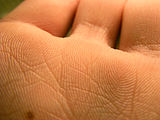

The glabrous (hairless) skin on the forepart of the hand, the palm, is relatively thick and tin can exist aptitude along the manus'southward flexure lines where the skin is tightly spring to the underlying tissue and bones. Compared to the residuum of the body'due south skin, the hands' palms (every bit well as the soles of the anxiety) are usually lighter — and even much lighter in night-skinned individuals, compared to the other side of the hand. Indeed, genes specifically expressed in the dermis of palmoplantar peel inhibit melanin product and thus the ability to tan, and promote the thickening of the stratum lucidum and stratum corneum layers of the epidermis. All parts of the skin involved in grasping are covered past papillary ridges (fingerprints) acting as friction pads. In contrast, the hairy skin on the dorsal side is thin, soft, and pliable, so that the skin can recoil when the fingers are stretched. On the dorsal side, the peel can exist moved beyond the hand upwardly to 3 cm (ane.2 in); an important input the cutaneous mechanoreceptors.[17]
The web of the hand is a "fold of pare which connects the digits".[18] These webs, located between each set of digits, are known every bit peel folds (interdigital folds or plica interdigitalis). They are defined equally "one of the folds of peel, or rudimentary web, between the fingers and toes".[19]
Variation
The ratio of the length of the alphabetize finger to the length of the ring finger in adults is afflicted past the level of exposure to male sex activity hormones of the embryo in utero. This digit ratio is below i for both sexes simply it is lower in males than in females on boilerplate.
Clinical significance

10-ray of the left hand of a x-year-onetime male child with polydactyly.
A number of genetic disorders affect the paw. Polydactyly is the presence of more than the usual number of fingers. One of the disorders that can crusade this is Catel-Manzke syndrome. The fingers may exist fused in a disorder known as syndactyly. Or in that location may exist an absence of 1 or more primal fingers—a condition known as ectrodactyly. Additionally, some people are born without i or both hands (amelia). Hereditary multiple exostoses of the forearm—also known every bit hereditary multiple osteochondromas—is another cause of hand and forearm deformity in children and adults.[twenty]
There are several cutaneous weather that tin bear on the manus including the nails.
The autoimmune disease rheumatoid arthritis can bear on the paw, particularly the joints of the fingers.
Some weather condition can be treated by hand surgery. These include carpal tunnel syndrome, a painful condition of the hand and fingers caused by compression of the median nerve, and Dupuytren's contracture, a status in which fingers bend towards the palm and cannot exist straightened. Similarly, injury to the ulnar nerve may result in a condition in which some of the fingers cannot exist flexed.
A common fracture of the hand is a scaphoid fracture—a fracture of the scaphoid bone, one of the carpal bones. This is the commonest carpal bone fracture and can be irksome to heal due to a limited blood flow to the bone. There are various types of fracture to the base of the pollex; these are known as Rolando fractures, Bennet'due south fracture, and Gamekeeper'due south thumb. Another mutual fracture, known as Boxer'southward fracture, is to the neck of a metacarpal. Ane can also have a broken finger.
Development
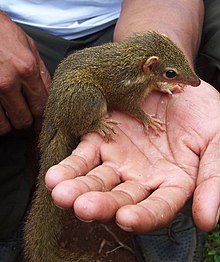
The prehensile hands and feet of primates evolved from the mobile easily of semi-arboreal tree shrews that lived nearly lx one thousand thousand years agone. This evolution has been accompanied by of import changes in the encephalon and the relocation of the eyes to the front of the face, together allowing the muscle control and stereoscopic vision necessary for controlled grasping. This grasping, also known as power grip, is supplemented by the precision grip between the thumb and the distal finger pads fabricated possible by the opposable thumbs. Hominidae (great apes including humans) caused an erect bipedal posture about iii.half dozen meg years ago, which freed the hands from the chore of locomotion and paved the style for the precision and range of motion in man hands.[21] Functional analyses of the features unique to the paw of modern humans have shown that they are consistent with the stresses and requirements associated with the constructive utilise of paleolithic stone tools.[22] It is possible that the refinement of the bipedal posture in the earliest hominids evolved to facilitate the use of the trunk equally leverage in accelerating the hand.[23]
While the man mitt has unique anatomical features, including a longer pollex and fingers that can be controlled individually to a higher degree, the hands of other primates are anatomically similar and the dexterity of the man hand tin can not be explained solely on anatomical factors. The neural machinery underlying hand movements is a major contributing factor; primates have evolved direct connections between neurons in cortical motor areas and spinal motoneurons, giving the cerebral cortex monosynaptic control over the motoneurons of the mitt muscles; placing the easily "closer" to the brain.[24] The recent evolution of the human manus is thus a direct issue of the development of the central nervous system, and the hand, therefore, is a direct tool of our consciousness — the primary source of differentiated tactile sensations — and a precise working organ enabling gestures — the expressions of our personalities.[25]


A gorilla, a big extant primate with small-scale thumbs, and the manus skeleton of Ardipithecus ramidus, a large Pliocene primate with relatively human-like thumbs
In that location are nevertheless several archaic features left in the human paw, including pentadactyly (having v fingers), the hairless skin of the palm and fingers, and the os centrale found in human embryos, prosimians, and apes. Furthermore, the precursors of the intrinsic muscles of the manus are present in the earliest fishes, reflecting that the paw evolved from the pectoral fin and thus is much older than the arm in evolutionary terms.[21]
The proportions of the human mitt are plesiomorphic (shared by both ancestors and extant primate species); the elongated thumbs and short easily more closely resemble the hand proportions of Miocene apes than those of extant primates.[26] Humans did not evolve from knuckle-walking apes,[27] and chimpanzees and gorillas independently acquired elongated metacarpals equally part of their adaptation to their modes of locomotion.[28] Several primitive hand features most probable present in the chimpanzee-man concluding mutual ancestor (CHLCA) and absent-minded in mod humans are all the same present in the hands of Australopithecus, Paranthropus, and Human floresiensis. This suggests that the derived changes in modern humans and Neanderthals did not evolve until two.5 to 1.5 million years agone or subsequently the advent of the primeval Acheulian stone tools, and that these changes are associated with tool-related tasks across those observed in other hominins.[29] The thumbs of Ardipithecus ramidus, an early on hominin, are nearly as robust equally in humans, so this may be a primitive trait, while the palms of other extant college primates are elongated to the extent that some of the thumb'southward original office has been lost (most notably in highly arboreal primates such as the spider monkey). In humans, the big toe is thus more derived than the pollex.[28]
There is a hypothesis suggesting the course of the modern human manus is especially conducive to the formation of a meaty fist, presumably for fighting purposes. The fist is compact and thus effective equally a weapon. It also provides protection for the fingers.[30] [31] [32] Even so, this is not widely accepted to exist ane of the main selective pressures acting on mitt morphology throughout human being evolution, with tool utilise and production being thought to be far more influential.[22]
Additional images
-

Illustration of Mitt and Wrist Bones.
-

Bones of the left hand. Volar surface.
-
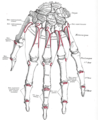
Bones of the left hand. Dorsal surface.
-
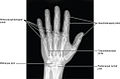
X-ray showing joints
See also
- Dactylonomy
- Dermatoglyphics
- Finger-counting
- Finger tracking
- Handstand
- Hand force
- Hand walking
- Human skeletal changes due to bipedalism
- Knuckle-walking
- Palmistry – fortune-telling based on lines in manus palms.
- Manus (anatomy)
- Mudra – Hindu term for hand gestures.
References
- ^ Thomas, Dorcas MacClintock; illustrated by J. Sharkey (2002). A natural history of raccoons. Caldwell, North.J.: Blackburn Press. p. fifteen. ISBN978-1-930665-67-v.
- ^ a b Xu, X; Clark, JM; Mo, J; Choiniere, J; Forster, CA; Erickson, GM; Hone, DWE; Sullivan, C; Eberth, DA; Nesbitt, S; Zhao, Q; Hernandez, R; Jia, CK; Han, FL; Guo, Y (2009). "A Jurassic ceratosaur from Mainland china helps clarify avian digital homologies" (PDF). Nature. 459 (7249): 940–944. Bibcode:2009Natur.459..940X. doi:10.1038/nature08124. PMID 19536256. S2CID 4358448.
{{cite journal}}: CS1 maint: multiple names: authors list (link) - ^ a b Latash, Mark Fifty. (2008). Synergy. Oxford University Press, USA. pp. 137–. ISBN978-0-nineteen-533316-ix.
- ^ Kivell, Tracy Fifty.; Lemelin, Pierre; Richmond, Brian G.; Schmitt, Daniel (2016). The Evolution of the Primate Paw: Anatomical, Developmental, Functional, and Paleontological Evidence. Springer. pp. seven–. ISBN978-1-4939-3646-5.
- ^ Goldfinger, Eliot (1991). Human Anatomy for Artists : The Elements of Class: The Elements of Form. Oxford University Press. pp. 177, 295. ISBN9780199763108.
- ^ O'Rahilly, Ronan; Müller, Fabiola (1983). Basic Human being Anatomy: A Regional Study of Man Construction. Saunders. p. 93. ISBN9780721669908.
- ^ a b Schmidt, Hans-Martin; Lanz, Ulrich (2003). Surgical Anatomy of the Hand. Thieme. p. 105. ISBN978-1-58890-007-4.
- ^ Marieb, Elaine N (2004). Homo Anatomy & Physiology (6th ed.). Pearson PLC. p. 237. ISBN978-0-321-20413-iv.
- ^ "Body Segment Data". ExRx.net.
- ^ Tubiana, Raoul; Thomine, Jean-Michel; Mackin, Evelyn (1998). Examination of the Hand and Wrist (2nd ed.). Taylor & Francis. p. iv. ISBN978-1-85317-544-2.
- ^ Saladin, Kenneth S. (2007) Anatomy & Physiology: The Unity of Form and Role. New York, NY: McGraw-Hill.
- ^ a b c d Tubiana, Raoul; Thomine, Jean-Michel; Mackin, Evelyn (1998). Exam of the Hand and Wrist (2d ed.). Taylor & Francis. pp. ix–xiv. ISBN978-i-85317-544-two.
- ^ Austin, Noelle M. (2005). "Chapter 9: The Wrist and Hand Circuitous". In Levangie, Pamela K.; Norkin, Cynthia C. (eds.). Joint Construction and Function: A Comprehensive Analysis (fourth ed.). Philadelphia: F. A. Davis Company. pp. 319–320. ISBN978-0-8036-1191-7.
- ^ "Anatomy, Shoulder and Upper Limb, Manus Intrinsic Muscles". NCBI. Retrieved November 28, 2020.
- ^ a b c Jones, Lynette A.; Lederman, Susan J. (2006). "Structure of the Pare". Human hand office . Oxford Academy Printing. pp. sixteen–eighteen. ISBN978-0-19-517315-four.
- ^ Ross, Lawrence Thousand.; Lamperti, Edward D., eds. (2006). Thieme Atlas of Anatomy: General Anatomy and Musculoskeletal Organization. Thieme. p. 257. ISBN978-1-58890-419-5.
- ^ Jones, Lynette A.; Lederman, Susan J. (2006). "Structure of the Skin". Human hand function . Oxford Academy Printing. pp. 18–21. ISBN978-0-19-517315-iv.
- ^ "Spider web". Oxford English Dictionary (Online ed.). Oxford University Press. (Subscription or participating establishment membership required.)
- ^ "web of fingers/ toes". Farlex Medical Dictionary. Farlex Partner Medical Lexicon. Retrieved 14 March 2016.
- ^ EL-Sobky, Tamer A.; Samir, Shady; Atiyya, Ahmed Naeem; Mahmoud, Shady; Aly, Ahmad S.; Soliman, Ramy (2018). "Electric current paediatric orthopaedic practice in hereditary multiple osteochondromas of the forearm: a systematic review". SICOT-J. 4: 10. doi:10.1051/sicotj/2018002. PMC5863686. PMID 29565244.
- ^ a b Schmidt, Hans-Martin; Lanz, Ulrich (2003). Surgical Beefcake of the Hand. Thieme. p. 1. ISBN978-1-58890-007-4.
- ^ a b Key, Alastair J.M.; Lycett, Stephen J. (2011). "Engineering science based development? A biometric test of the effects of handsize versus tool class on efficiency in an experimental cutting job". Periodical of Archaeological Science. 38 (7): 1663–1670. doi:10.1016/j.jas.2011.02.032.
- ^ Marzke, Mary. "Development of the hand and bipedality". Massey Academy, NZ. Retrieved September 21, 2017.
- ^ Flanagan, J Randall; Johansson, Roland S (2002). "Hand Movements" (PDF). Encyclopedia of the human encephalon. Elsevier Science.
- ^ Putz, RV; Tuppek, A. (Nov 1999). "Evolution of the hand". Handchir Mikrochir Plast Chir. 31 (half-dozen): 357–61. doi:ten.1055/s-1999-13552. PMID 10637723.
- ^ Almécija, Sergio (2009). "Evolution of the hand in Miocene apes: implications for the appearance of the man hand (PhD Thesis)" (PDF). Universitat Autònoma de Barcelona. Archived from the original (PDF) on 2016-03-24. Retrieved 2011-12-25 .
- ^ Kivella, Tracy L.; Schmitt, Daniel (August 25, 2009). "Independent evolution of knuckle-walking in African apes shows that humans did non evolve from a knuckle-walking ancestor". PNAS. 106 (34): 14241–14246. Bibcode:2009PNAS..10614241K. doi:10.1073/pnas.0901280106. PMC2732797. PMID 19667206.
- ^ a b Lovejoy, C. Owen; Suwa, Gen; Simpson, Scott W.; Matternes, Jay H.; White, Tim D. (October 2009). "The Slap-up Divides: Ardipithecus ramidus Reveals the Postcrania of Our Last Common Ancestors with African Apes". Scientific discipline. 326 (5949): 101–102. Bibcode:2009Sci...326..100L. doi:10.1126/scientific discipline.1175833. PMID 19810199. S2CID 19629241.
- ^ Tocheri, Matthew W.; Orr, Caley 1000.; Jacofsky, Marc C.; Marzke, Mary W. (2008). "The evolutionary history of the hominin manus since the last mutual antecedent of Pan and Homo" (PDF). J. Anat. 212 (iv): 544–562. doi:x.1111/j.1469-7580.2008.00865.x. PMC2409097. PMID 18380869. )
- ^ Reardon, Sara (Dec 19, 2012). "Human easily evolved and so nosotros could dial each other". New Scientist . Retrieved September 21, 2017.
- ^ Knight, Kathryn (2012). "Fighting Shaped Human Easily". The Periodical of Experimental Biology. 216 (2): i.1–i. doi:ten.1242/jeb.083725.
- ^ Morgan, Michael H.; Carrier, David R. (January 2013). "Protective buttressing of the man fist and the evolution of hominin hands". J Exp Biol. 216 (2): 236–244. doi:x.1242/jeb.075713. PMID 23255192.
External links
- Hand anatomy (eMedicine)
- Moving-picture show Lath of Canada documentary Faces of the Hand (Requires Adobe Flash)
- The Mutual Hand article in the May 2012 National Geographic
Source: https://en.wikipedia.org/wiki/Hand
0 Response to "Hand & Stone Massage and Facial Spa Reviews"
Publicar un comentario